In today’s digital world, businesses are constantly looking for ways to increase their online presence, attract potential customers, and drive sales. Two of the most effective strategies for achieving this are SEO (Search Engine Optimization) and SEM (Search Engine Marketing). While both aim to enhance your visibility on search engines, they work differently and offer unique advantages. Understanding these differences is crucial for any business looking to succeed online.
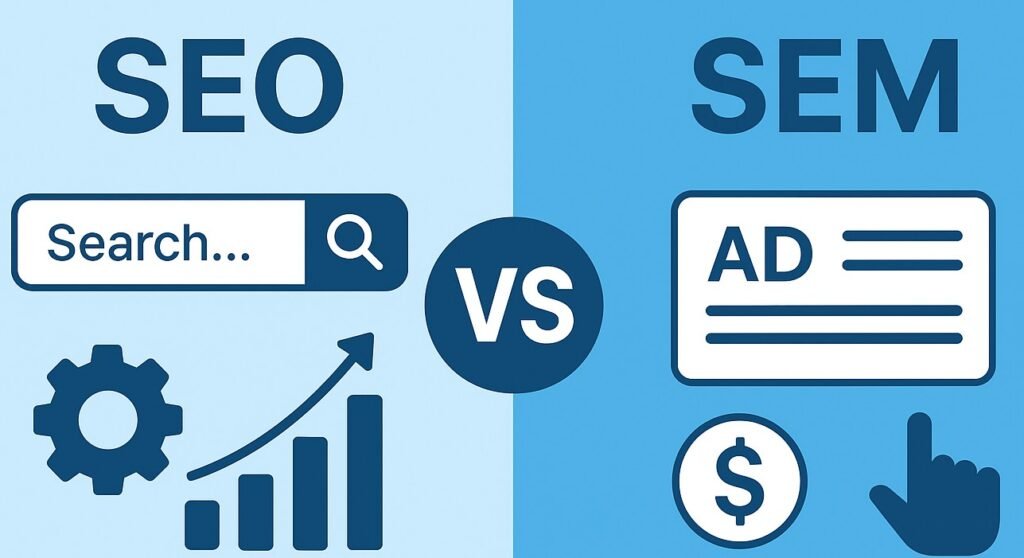
What is SEO (Search Engine Optimization)?
SEO, or Search Engine Optimization, is the process of optimizing your website to rank higher in organic (non-paid) search results on search engines like Google, Bing, and Yahoo. It involves several techniques designed to improve both the quantity and quality of traffic to your website.
SEO is divided into three main types:
1. On-Page SEO
On-page SEO focuses on optimizing elements within your website. Key aspects include:
- Keyword Optimization: Using relevant keywords that your target audience is searching for.
- Content Quality: Creating informative, engaging, and original content.
- Meta Tags: Optimizing meta titles, descriptions, and headings (H1, H2, H3).
- URL Structure: Using clean, readable, and keyword-rich URLs.
- Internal Linking: Linking between pages to improve navigation and SEO value.
2. Off-Page SEO
Off-page SEO refers to activities outside your website that influence your search ranking. This includes:
- Backlinks: Getting high-quality backlinks from authoritative websites.
- Social Signals: Engagement on social media platforms can indirectly affect SEO.
- Guest Blogging: Writing content on other sites to build authority and links.
3. Technical SEO
Technical SEO ensures that your website is easily crawlable and indexable by search engines. Key elements include:
- Site Speed: Faster websites rank higher and provide a better user experience.
- Mobile Optimization: Ensuring your site works perfectly on mobile devices.
- SSL Security: Websites with HTTPS are preferred by Google.
- Sitemap & Robots.txt: Helps search engines crawl and index your website efficiently.
Benefits of SEO:
- Long-term traffic growth
- Cost-effective compared to paid advertising
- Builds trust and credibility with users
- Improves user experience
What is SEM (Search Engine Marketing)?
SEM, or Search Engine Marketing, is a paid digital marketing strategy designed to increase a website’s visibility on search engine results pages (SERPs). Unlike SEO, which focuses on organic traffic, SEM uses paid advertising to get immediate results.
The most common SEM platform is Google Ads, but other search engines like Bing also offer paid search advertising options. SEM typically uses PPC (Pay-Per-Click) campaigns, where advertisers pay a fee each time their ad is clicked.
Key Components of SEM:
- Keyword Research
Just like SEO, SEM requires thorough keyword research. However, in SEM, you bid on keywords to display your ads when users search for them. High-competition keywords may cost more, while long-tail keywords are often more affordable. - Ad Creation
Creating compelling ads is crucial for SEM success. This includes:
- Ad Headlines: Catchy and relevant to the search query
- Ad Copy: Clear, persuasive, and action-oriented
- Display URL: Optimized to reflect your brand and keywords
- Landing Pages
A well-optimized landing page ensures that visitors convert after clicking your ad. This includes:
- Clear call-to-action (CTA) buttons
- Relevant content aligned with the ad
- Fast-loading and mobile-friendly design
- Bid Management & Budgeting
SEM campaigns require strategic budgeting. You need to manage bids on keywords to maximize ROI while staying within budget. - Analytics & Optimization
Tracking campaign performance is essential. Tools like Google Ads Dashboard and Google Analytics help measure:
- Click-through rates (CTR)
- Conversion rates
- Cost per click (CPC)
- Return on ad spend (ROAS)
Benefits of SEM:
- Immediate visibility on search engines
- Highly targeted audience based on keywords and location
- Measurable and trackable results
- Flexible budgeting options
SEO vs. SEM: Key Differences
| Aspect | SEO | SEM |
|---|---|---|
| Cost | Free (organic traffic) | Paid (ads & campaigns) |
| Time to See Results | Medium to long-term (months) | Immediate (days/weeks) |
| Traffic Source | Organic | Paid |
| Sustainability | Long-lasting results | Stops when the budget ends |
| Credibility | Builds trust and authority | Perceived as an advertisement |
| Targeting | Keyword-focused, broader reach | Highly targeted by demographics, location, device |
Both SEO and SEM complement each other. While SEO builds long-term authority and organic traffic, SEM ensures immediate visibility and can be highly targeted for promotions or new product launches.
How to Combine SEO and SEM for Maximum Results
Integrating SEO and SEM strategies can significantly enhance your digital marketing efforts:
- Keyword Strategy Alignment
Use SEO data to identify high-performing keywords for SEM campaigns. This ensures consistency across organic and paid searches. - Retargeting Visitors
SEM allows retargeting of visitors who reached your site via SEO but didn’t convert. This increases conversion chances. - Content Optimization
High-quality content created for SEO can be promoted through SEM campaigns to increase visibility and engagement. - Data-Driven Decisions
Analyzing SEM performance can provide insights into which keywords and content work best, which can then improve SEO strategy.
Conclusion
Both SEO and SEM are critical for any business that wants to thrive in the online landscape. SEO focuses on long-term, sustainable growth by improving organic search rankings, while SEM provides immediate visibility and highly targeted traffic through paid campaigns.
At Click N Grow Digital, we specialize in creating integrated SEO and SEM strategies tailored to your business goals. Whether you want to increase organic traffic, run high-performing paid campaigns, or both, our experts ensure that your brand achieves maximum online visibility and measurable results.
Investing in both SEO and SEM is not just a marketing decision—it’s a growth strategy. By understanding and leveraging the strengths of each, businesses can dominate search results, attract qualified leads, and achieve sustainable online success.